


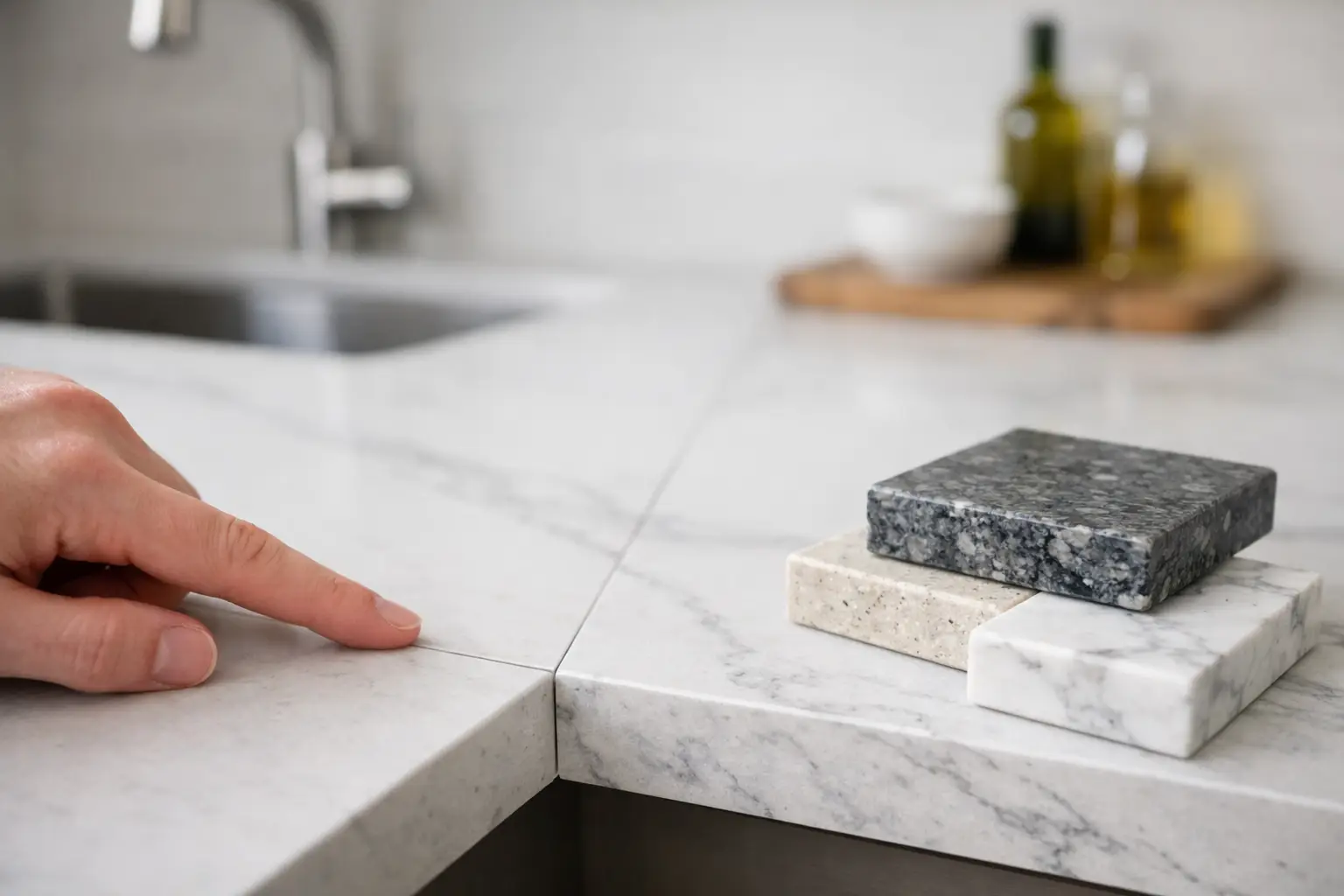
Countertop seams can be visible when installing granite, quartz, marble, or quartzite surfaces. Although professional installers aim to create smooth, attractive connections between slabs, some seams remain visible after installation.
Countertop seams become visible because of differences in slab colour, natural veining, adhesive matching, surface alignment, and installation techniques. In many cases, seams are necessary because countertop dimensions exceed available slab sizes or the kitchen layout requires multiple stone pieces.
Understanding why countertop seams appear helps homeowners set realistic expectations, spot installation issues, and make informed renovation decisions.
What Is a Countertop Seam?
A countertop seam is the joint where two separate countertop pieces meet. Installers use specialised adhesives to connect these sections and create a continuous working surface.
Seams are commonly required around large kitchen islands, L-shaped countertops, corners, and areas where slab dimensions cannot accommodate the entire installation.
During professional Countertop Installation in Orlando, contractors evaluate slab measurements, cabinet support, countertop layouts, and material patterns to determine appropriate seam locations.
Although a well-executed seam should be narrow, stable, and properly aligned, complete invisibility cannot always be guaranteed.
What Causes Countertop Seams to Become Visible?
Several factors influence how noticeable countertop seams appear after installation.
Natural Differences in Stone Patterns
Granite, marble, and quartzite contain natural variations in colour, veining, and mineral distribution.
When two sections meet, their patterns may not align perfectly, making the joint more noticeable.
Even slabs from the same stone variety can display different patterns.
For homeowners planning Kitchen Renovation Services in Hialeah, reviewing slab layouts before fabrication can help minimise noticeable transitions between adjoining countertop sections.
Incorrect Adhesive Colour Matching
Installers commonly use stone-compatible adhesives to join countertop pieces.
If the adhesive colour contrasts with the countertop, the seam may appear as a distinct line.
For example, a dark adhesive applied between light-colored quartz sections can make the connection more visible.
Professional installers select suitable adhesive colours and carefully finish the joint to reduce unnecessary contrast.
Uneven Cabinet Support
Countertops require stable, properly aligned support underneath their surfaces.
If base cabinets are uneven, incorrectly positioned, or insufficiently secured, adjoining countertop sections may sit at different heights.
This creates a noticeable seam and can contribute to long-term movement.
Professional Cabinet Installation in Miami should include checking cabinet levels, structural stability, and countertop support requirements before stone installation begins.
Poor Countertop Edge Preparation
Countertop pieces must have accurately fabricated edges to achieve a clean connection.
Uneven cutting, chipped edges, or inaccurate measurements can create wider gaps between sections.
These gaps require additional adhesive and may become more noticeable after installation.
Precise fabrication and careful handling are essential for maintaining consistent seam quality.
Improper Seam Placement
Seam location can significantly influence countertop appearance.
A joint positioned across a prominent kitchen island may attract more attention than one located in a less visible area.
However, installers must also consider slab dimensions, structural support, sink openings, and fabrication limitations.
During Home Renovation Services in Kendall, discussing seam placement before countertop fabrication can help homeowners balance appearance with installation requirements.
Lighting and Surface Reflection
Kitchen lighting can make countertop seams more noticeable.
Under-cabinet lighting, pendant lights, and sunlight may highlight small differences in surface height, texture, or adhesive finish.
Polished countertops can make these differences particularly visible because their reflective surfaces emphasise irregularities.
Proper alignment and finishing help reduce these visual effects.
Are Visible Countertop Seams Normal?
Yes. Some seam visibility is normal, especially with natural stone countertops featuring distinctive patterns.
However, there is an important difference between an acceptable visible seam and a poorly installed joint.
A professionally installed seam should generally have:
- Closely aligned countertop sections
- Appropriate adhesive colour
- Minimal unnecessary gaps
- Smooth transitions between surfaces
- Stable support beneath adjoining pieces
- No significant chipping or separation
A visible seam does not automatically indicate defective workmanship.
However, noticeable height differences, widening gaps, loose sections, or deteriorating adhesive may require professional inspection.
Can Countertop Seams Become More Visible Over Time?
Yes. Countertop seams can become more noticeable after installation due to several conditions.
Cabinet Movement or Settlement
Changes in cabinet support may create slight movement between countertop sections, affecting seam alignment.
Adhesive Discoloration
Certain adhesives may discolour over time because of ageing, staining, chemical exposure, or unsuitable cleaning products.
Moisture Exposure
Water entering poorly sealed joints can affect surrounding materials and potentially compromise the countertop support system.
This is particularly relevant in kitchens and bathrooms where moisture exposure is frequent.
During Bathroom Renovation Services in Weston, contractors should evaluate countertop joints, vanity support, and moisture-resistant installation practices.
Excessive Weight or Impact
Heavy loads near unsupported countertop joints may contribute to movement, cracking, or adhesive deterioration.
Proper support is especially important around large overhangs and countertop openings.
How Can Homeowners Reduce Visible Countertop Seams?
Homeowners can take several practical steps before countertop installation begins.
Review the slab layout: Ask the fabricator to explain where seams will appear and how adjoining patterns will align.
Choose appropriate materials: Countertops with subtle, consistent patterns may make seams less noticeable than materials featuring dramatic veining.
Check cabinet preparation: Ensure base cabinets are properly installed and capable of supporting the countertop.
Discuss adhesive matching: Confirm that the installer plans to use a suitable adhesive colour.
Inspect fabrication details: Accurate measurements and professionally prepared edges help achieve cleaner connections.
Homeowners coordinating Floor Renovation Services in Hollywood or Tile Installation in Brickell alongside countertop upgrades should also plan installation schedules carefully to avoid unnecessary damage to completed surfaces.
Can Visible Countertop Seams Be Repaired?
Some countertop seam problems can be repaired, depending on their cause and severity.
A professional may be able to remove deteriorated adhesive, clean the joint, realign sections, or apply appropriately matched bonding materials.
However, significant slab movement, structural damage, or incorrectly fabricated edges may require more extensive corrections.
Homeowners should avoid attempting major seam repairs without professional guidance because improper adhesives or excessive force can damage stone surfaces.
Frequently Asked Questions
Should quartz countertop seams be invisible?
No. Quartz seams can be less noticeable with careful colour matching and fabrication, but completely invisible joints are not guaranteed.
Where should countertop seams be placed?
Seam placement depends on slab dimensions, countertop design, support conditions, and fabrication requirements.
Can countertop seams crack?
Yes. Movement, insufficient support, impact, or adhesive failure can contribute to cracking or separation.
Are countertop seams waterproof?
Properly bonded seams can resist ordinary moisture exposure, but homeowners should avoid prolonged water accumulation and maintain joints appropriately.
Conclusion
Countertop seams become visible because of material patterns, adhesive differences, fabrication accuracy, cabinet alignment, and installation conditions.
While some visibility is unavoidable, careful planning and professional workmanship can significantly improve the finished appearance.
HRM Florida provides countertop installation, cabinet installation, kitchen remodelling, and home renovation services. Our team helps homeowners evaluate installation requirements, coordinate renovation work, and achieve functional, attractive countertop surfaces.
Understanding countertop seams before installation allows homeowners to make better material choices, establish realistic expectations, and protect their renovation investment.
